Offshore 1
$3.09/ month
3 mo $8.346 mo $14.8312 mo $25.95
- 1 vCPU
- 1 GB RAM
- 20 GB NVMe
- 2 TB traffic
Monero VPS · XMR payments
Nymhost takes payment only in crypto, and Monero is the one coin of the seven whose sender and amount stay off block explorers. Here is what a Monero payment hides, what Nymhost still knows, how long you wait, and which plan can hold a Monero node.
Monero payments at a glance
You can buy a VPS with Monero at Nymhost: choose XMR at checkout, top up your balance by at least $25, and send the exact amount shown. The payment needs 10 confirmations, which is about 20 minutes at Monero's 2-minute block time. A block explorer shows neither the sender nor the amount. Nymhost still keeps your account number, the amount and the transaction ID, but needs no email, name or ID. A person builds the server within 1 hour of the confirmation. Plans start at $3.09 a month.
Monero is built so that the public ledger does not show who paid whom, or how much. Three mechanisms do the work, and the Monero project describes each on its own pages.
For you, the result is simple: a block explorer shows neither the sender nor the amount of a Monero payment to Nymhost. That is the difference with Bitcoin, USDT or Litecoin, where the payment is a public record, as the guide to buying a VPS with crypto explains.
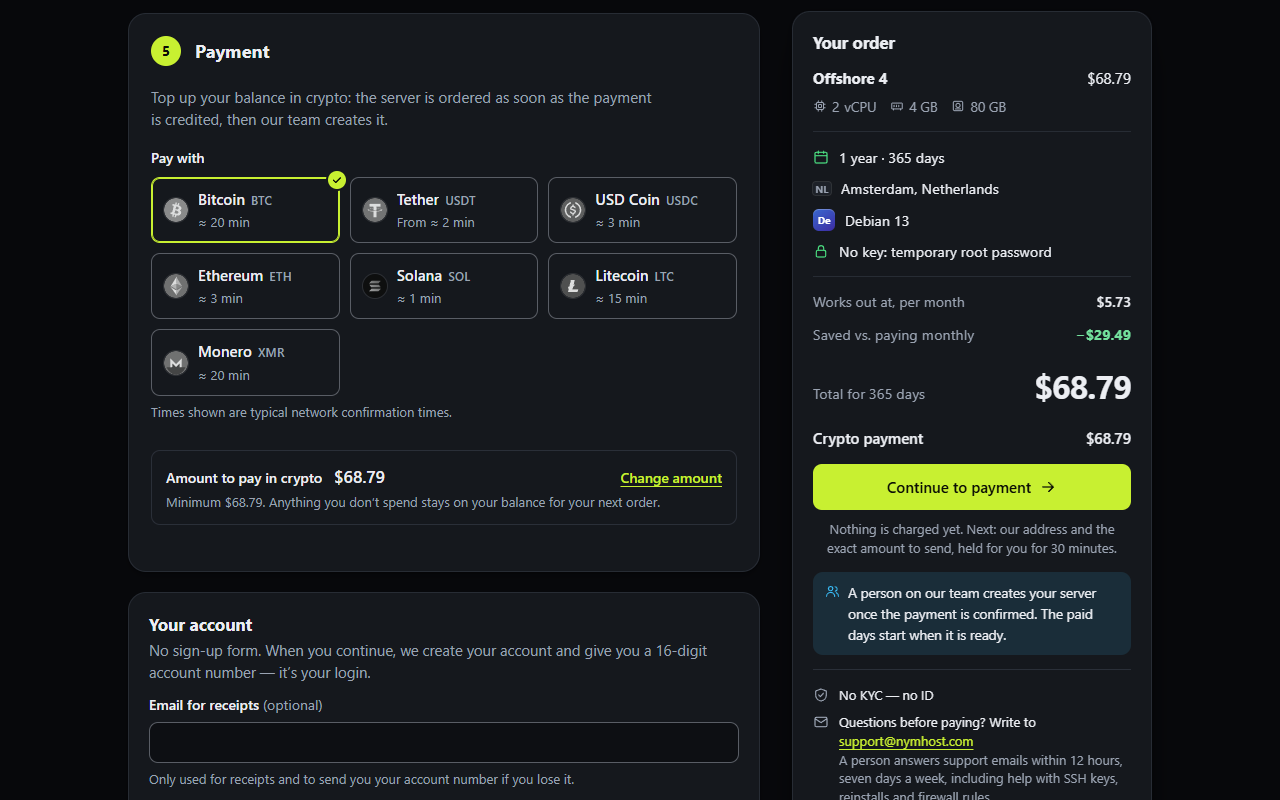
The steps match any other coin, with Monero's own waiting time. Paying for a VPS with XMR takes five steps:
Choose a plan, one of the 9 cities, a Linux system and 1, 3, 6 or 12 months. The longer rentals save 10%, 20% or 30%. Add an SSH public key or let the team set a temporary root password.
The checkout gives you a 16-digit account number as your login. No email is needed. Without an email, a lost number cannot be recovered.
The page shows a Monero address and an exact amount for a top-up of at least $25. Send that amount from your own wallet, in one transaction. Official wallets are listed on the Monero downloads page.
Your balance is credited after 10 blocks. The checkout shows about 20 minutes, which matches Monero's target of one block every 2 minutes. Busy or slow periods can stretch it.
The VPS is charged from the balance. A person builds it, usually within minutes and never more than 1 hour after the payment confirms. The dashboard then shows the IP address, and you log in as root over SSH.
At Nymhost a Monero payment needs 10 confirmations. The Monero project says a new block is added once every 2 minutes on average (blocks), and its technical specification lists the block time as 2 minutes (technical specification). Ten blocks at two minutes make about 20 minutes, the same figure the checkout shows for Monero. It is an average, not a promise.
For comparison, Nymhost waits for 1 confirmation on Solana, 2 on Bitcoin, 6 on Litecoin, 12 on Ethereum and USDC, and 20 for USDT on Tron. A count is not a duration: each chain adds blocks at its own pace, so 20 confirmations of USDT on Tron take about 2 minutes on the checkout's figures, while 2 confirmations of Bitcoin take about 20.
Monero hides the payment on the blockchain. It does not hide the account on Nymhost's side. Here is the split.
Billing links your account number to your orders, to the IP addresses of your VPS and to the transaction ID of each payment. Your server's traffic also crosses the data-center network. Nymhost LLC is registered in New Mexico, United States, so it can receive US legal process; it hands over the records it has only when the law requires it, on a valid court order or another legally binding request. Paying in Monero does not change what those records contain. Where you obtained the XMR matters too: an exchange that checked your ID knows you bought coins, even if the later payment is private.
Sanctions lists and Monero. On every other coin, the address a payment comes from is looked up on public sanctions lists of blockchain addresses, and a payment from a listed address is not credited. A Monero payment hides that address, so the lookup has nothing to compare; the service stays closed to the countries listed in the questions below. Read more on the no-KYC VPS page.
A Monero node of your own gives your wallet a server it can trust instead of a public one, and a pruned node can also serve other wallets. Before you order a VPS for a Monero node, check two things: the disk and the RAM.
The Monero technical specification gives the blockchain at about 105 GiB for a pruned node and about 265 GiB for a full node, both as of 5 October 2026 (technical specification). The project's pruning page says pruning saves 2/3 of the storage while keeping the full transaction history (pruning). Its guide to running a node as a service recommends 262.5 GiB or more of SSD for a pruned node, 662.5 GiB or more for a full node, and 4 GB or more of RAM, which leaves room for the chain to grow (systemd guide).
In gigabytes, that is about 113 GB pruned and 285 GB full; the guide asks for about 282 GB and 711 GB.
| Plan | NVMe and RAM | Pruned node (about 113 GB) | Full node (about 285 GB) | Verdict |
|---|---|---|---|---|
| Offshore 4 | 80 GB, 4 GB | Does not fit | Does not fit | Too small for a node |
| Offshore 8 | 160 GB, 8 GB | Fits, about 47 GB free | Does not fit | Pruned node today; below the guide's 262.5 GiB, so watch the disk |
| Offshore 16 | 320 GB, 16 GB | Fits, about 207 GB free | Fits, about 35 GB free | Pruned node within the guide's figure; a full node is a tight fit |
| Global 24 | 400 GB, 24 GB | Fits, about 287 GB free | Fits, about 115 GB free | Most headroom; still below the guide's 662.5 GiB for a full node |
No plan reaches 662.5 GiB, so a full node here is one you will outgrow. Global 24 runs in the US, London, Amsterdam and Frankfurt.
Prune from the first sync: the monerod reference says adding the pruning option later only prunes logically, without shrinking the file. A node is not mining, but cryptocurrency mining is forbidden on Nymhost: if in doubt, ask support first. Going over the monthly traffic quota (12 TB on Offshore 8 and Global 24, 20 TB on Offshore 16) never triggers an automatic charge. Installing and running the node step by step is on the blockchain node VPS page, next to pruned Bitcoin and Lightning nodes.
These plans can all be paid in Monero. The offshore range runs in Amsterdam, Reykjavik, Zurich and Bucharest, with more disk and traffic per dollar, which suits a node. See offshore VPS locations for each city's legal setting, and every length and both ranges on the VPS prices page.
Amsterdam · Reykjavik · Zurich · Bucharest
$3.09/ month
3 mo $8.346 mo $14.8312 mo $25.95
$4.89/ month
3 mo $13.206 mo $23.4712 mo $41.07
$8.19/ month
3 mo $22.116 mo $39.3112 mo $68.79
$13.49/ month
3 mo $36.426 mo $64.7512 mo $113.31
$20.49/ month
3 mo $55.326 mo $98.3512 mo $172.11
Prices in US dollars, checked on 18 November 2026. Paid from a crypto balance (minimum top-up $25); 3, 6 and 12 months save 10, 20 and 30%. Every plan: KVM, root over SSH, 1 dedicated IPv4 + /64 IPv6, shared 1 Gbit/s port.
Yes. Monero is one of the seven coins accepted. Choose XMR at checkout, send the exact amount shown for a top-up of at least $25, and wait for 10 confirmations. The VPS is then paid from your balance for 1, 3, 6 or 12 months.
The payment is private on the blockchain: a block explorer shows neither the sender nor the amount. Nymhost still holds your account number, the amount and the transaction ID, and your server's traffic crosses the data-center network. No name, email, ID or connection logs are kept, and what is kept goes out only on a valid court order or another binding legal request.
No. You sign in with a 16-digit account number. An email is optional and only helps recover a lost number. With no email on file, a lost number is gone for good.
10 confirmations. The checkout shows about 20 minutes, which matches Monero's block target of 2 minutes. After that, a person builds the server, never more than 1 hour later.
Yes, as long as the exact amount shown arrives, after the exchange's withdrawal fee. The payment stays private on the blockchain, but the exchange keeps its own record: paid straight from the exchange, it knows the address you sent to; paid from your own wallet, it only knows the withdrawal to you. If the exchange checked your ID, that record carries your name.
No. No coin comes with KYC here: whatever you pay with, Nymhost asks for no ID, no selfie, no documents, no card and no phone number. The difference is the blockchain. A Bitcoin, USDT, USDC, Ethereum, Solana or Litecoin payment is public and its sending address is checked against sanctions lists; a Monero payment shows neither the sender nor the amount.
A pruned node (about 105 GiB as of 5 October 2026) fits on Offshore 8 or larger; a full node (about 265 GiB) needs Offshore 16 or Global 24, with little room to grow on Offshore 16. The table in the node section gives the free space on each plan.
On every coin except Monero, the sending address is looked up on public sanctions lists of blockchain addresses. A Monero payment hides that address. The service is still closed to people and companies in Cuba, Iran, North Korea, Syria, Russia, Belarus, China, Yemen and Western Sahara, and in the occupied regions of Ukraine.
Choose a plan, send XMR, and log in as root. Nothing personal is asked and no connection logs are kept.