Offshore 1
$3.09/ month
3 mo $8.346 mo $14.8312 mo $25.95
- 1 vCPU
- 1 GB RAM
- 20 GB NVMe
- 2 TB traffic
No KYC VPS hosting
Nymhost never asks for an ID, a selfie or a phone number, and it takes no card: crypto is the only way to pay. Here is the exact list of what it keeps, what other hosts ask at sign-up, and what no KYC does not hide.
Short answer
KYC means "know your customer": a host checks who you are before it sells to you. A no KYC VPS skips that. At Nymhost there is no ID, no selfie, no documents, no card and no phone number; your login is a 16-digit account number and an email address is optional. You top up a prepaid balance in crypto (minimum $25) and rent a Linux KVM VPS from $3.09 a month. No KYC does not hide everything: a Bitcoin or USDT payment sits on a public blockchain, and your traffic crosses the data-center network. A payment in Monero is the exception for the blockchain.
This is what a no-KYC order leaves in Nymhost's records, step by step, as written in the privacy policy.
Nymhost is run by Nymhost LLC, a limited liability company registered in New Mexico, United States, so US legal process can reach it. It hands over the records it has only when the law requires it: a valid court order or another legally binding request. With no connection or traffic logs, those records are the billing data listed under "Recorded, and when".
KYC is an identity check: a name, a document, often a photo of your face. Among hosts, the usual trigger is payment. A host that takes cards or routes crypto through a payment gateway depends on that processor: OrangeWebsite's terms name its crypto gateways, BitPay and CoinPayments, and say these providers "reserve the right to request KYC". Others write the right into their own terms, or ask at refund time.
Nymhost takes no card payments. You top up a balance by sending crypto, and nothing in the order flow collects a document.
The table lists what each provider's own pages said, and when we read them: 18 November 2026 for most rows, 29 October 2026 for the oldest. It is a snapshot; check the provider before you order. The list is not complete and it is not a ranking. A longer comparison is in the best anonymous VPS providers, side by side. Hetzner's identity check, and what its terms say about the workarounds, are on the does Hetzner accept crypto page.
| Provider | Asked at sign-up | When more may be asked | Read on |
|---|---|---|---|
| Nymhost | Account number; email optional | Never: no KYC | 18 November 2026 |
| AliasVPS | Email and password; its terms say it collects no identity documents and accepts a pseudonym | Not stated in its terms | 18 November 2026 |
| BitLaunch | Email address and password only | Not stated on the page read | 18 November 2026 |
| Njalla | An email or an XMPP address | Not stated on the pages read | 10 November 2026 |
| 1984 Hosting | Email, password, optional phone | Not stated on the pages read | 29 October 2026 |
| OrangeWebsite | Email only | Its crypto gateways, BitPay and CoinPayments, may request KYC | 18 November 2026 |
| Cloudzy | Email; a one-time identity check before the first crypto order | Also when it suspects fraud, abuse or a security risk | 18 November 2026 |
| AbeloHost | Terms allow KYC at any time, with government photo ID | 29 October 2026 | |
| HOSTKEY | Email and password; ID can be required | Runs a mandatory KYC and AML procedure | 29 October 2026 |
FlokiNET's privacy page stated no ID and no KYC when read on 29 October 2026. Two hosts that do not ask for ID at sign-up ask on refunds, according to their own pages read on 18 November 2026: AlexHost's payment gateway may require a government-issued passport, and MonoVM rejects refund requests sent without KYC documents.
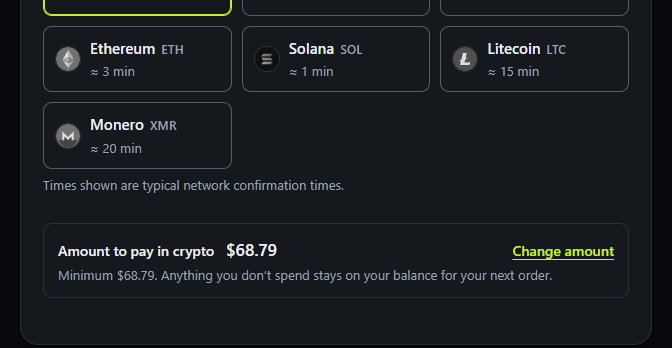
A VPS without ID verification still has to answer one question: who pays? Nymhost's answer is a balance funded in crypto, the only way to pay. No card, no PayPal and no bank transfer are taken, so nothing in the payment step asks for your name or an ID. The checkout creates an account number, you send the exact amount shown for the coin and network you chose, at least $25, and the balance is credited after the confirmations: 2 for Bitcoin, 10 for Monero, 12 for Ethereum and USDC, 20 for USDT on Tron. The VPS is paid from that balance, and what is left never expires.
No verification also means no way to recover you. Your account number is your login, and with no email on file a lost number is gone for good. Write it down.
Nobody from support will ever ask for your account number, your root password or your private SSH key.
An email address is optional and only serves recovery. See buy a VPS with crypto for the full list of coins and networks.
"Anonymous VPS without KYC" means Nymhost does not ask who you are. It does not mean nobody can learn it.
Also: accounts are for people aged 18 or over, and Nymhost is not available in Cuba, Iran, North Korea, Syria, Russia, Belarus, China, Yemen, Western Sahara or the occupied regions of Ukraine. No KYC does not permit spam, phishing, malware, attacks or child sexual abuse material: they lead to suspension.
Nymhost asking nothing does not undo a check made earlier, where you got the coins. Three cases:
So a VPS with no verification at the host can still be linked to you through where your coins came from. This page explains limits; it is not legal advice and does not encourage anyone to break a law.
Nymhost does not collect your identity. What you do around it decides the rest.
It is the one coin where the sender and the amount are not on a public explorer. It needs 10 confirmations. See buy a VPS with Monero.
Skip the optional email. You then have no address to recover an account number, so store it carefully.
Add your public key at checkout and password login stays off. Without it, the team sets a temporary root password in your dashboard that you change at first login.
The data center follows the law of its own country. Pick an offshore location if you want the server outside your own country, and see how copyright and DMCA notices are handled.
Do not reuse a nickname, an email or a payment address from your identity.
Ten KVM plans in two ranges, with NVMe storage and a dedicated IPv4 address. Offshore plans run in Reykjavik, Zurich, Bucharest and Amsterdam; Global plans run in New York, Dallas, Los Angeles, London, Amsterdam and Frankfurt. Renting 3 months saves 10%, 6 months 20% and 12 months 30%. There is no hourly billing and no free trial.
Amsterdam · Reykjavik · Zurich · Bucharest
$3.09/ month
3 mo $8.346 mo $14.8312 mo $25.95
$4.89/ month
3 mo $13.206 mo $23.4712 mo $41.07
$8.19/ month
3 mo $22.116 mo $39.3112 mo $68.79
$13.49/ month
3 mo $36.426 mo $64.7512 mo $113.31
$20.49/ month
3 mo $55.326 mo $98.3512 mo $172.11
New York · Dallas · Los Angeles · London · Amsterdam · Frankfurt
$3.19/ month
3 mo $8.616 mo $15.3112 mo $26.79
$6.39/ month
3 mo $17.256 mo $30.6712 mo $53.67
$9.59/ month
3 mo $25.896 mo $46.0312 mo $80.55
$19.19/ month
3 mo $51.816 mo $92.1112 mo $161.19
$29.39/ month
3 mo $79.356 mo $141.0712 mo $246.87
Prices in US dollars, checked on 18 November 2026. Paid from a crypto balance (minimum top-up $25); 3, 6 and 12 months save 10, 20 and 30%. Every plan: KVM, root over SSH, 1 dedicated IPv4 + /64 IPv6, shared 1 Gbit/s port.
A virtual server rented without an identity check. At Nymhost there is no ID, no selfie, no documents, no card and no phone number. You get a 16-digit account number as your login, and an email is optional.
On their own pages read on 18 November 2026, AliasVPS and BitLaunch asked for an email and password only, and OrangeWebsite for an email only, though its payment gateways may request KYC. Cloudzy now checks identity before a first crypto order. The table above lists nine hosts with dates.
No. There is no KYC step at sign-up, at a refund or at a renewal. The only check is automatic: on every coin except Monero, the sending address is compared with public sanctions lists of blockchain addresses before a payment is credited.
Yes. Sign in with an account number. The cost is recovery: with an email on file you can recover a lost account number, and with none, a lost number is gone for good.
Not fully. A Bitcoin or USDT payment stays on a public blockchain, billing links your account number to your orders and IP addresses, and your traffic crosses the data center. Monero hides the sender and the amount. See the section above.
At Nymhost the two go together: no connection logs, no traffic logs and no visitor IP addresses on the website, the dashboard or the VPS. It keeps accounts, orders, top-ups and VPS details. Details are in Nymhost's privacy rules.
Seven coins are accepted: Bitcoin, Monero, USDT on Tron or Ethereum, USDC, Ethereum, Solana and Litecoin, through a prepaid balance with a $25 minimum top-up. The coin table lists networks and confirmations.
Sign up with an account number and nothing else, from $3.09 a month. An email stays optional.